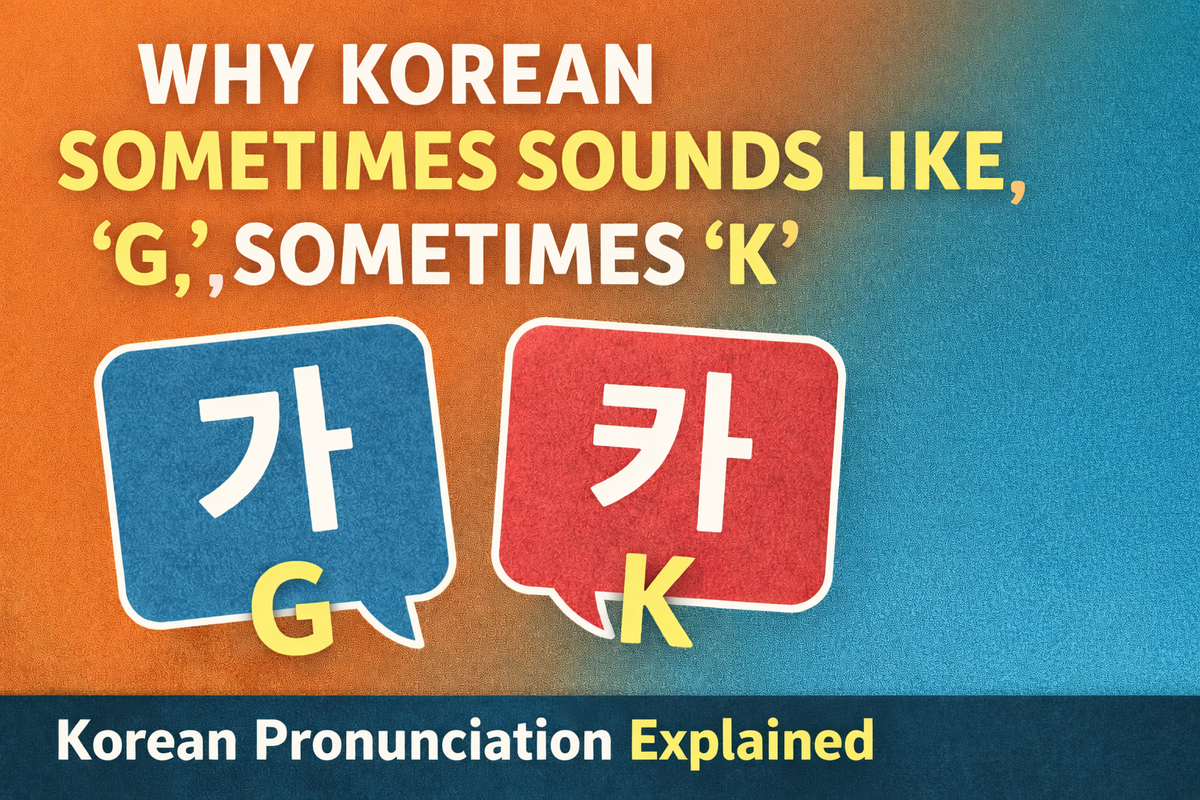
Why Korean Sometimes Sounds Like “G” and Sometimes Like “K”
Why does Korean ㄱ sometimes sound like G and sometimes like K? And why does ㅅ sometimes sound like SH? A Korean teacher explains the pronunciation differences that confuse many language learners.
Recently, I had an interesting experience while teaching Korean pronunciation.
Native Korean speakers usually do not pay much attention to small pronunciation differences. One example is the consonant ㄱ. In Korean, this sound can sometimes be heard as [g] and sometimes as [k], depending on its position in a word or the sounds around it.
However, most Korean speakers don’t consciously think about this difference. Whether someone pronounces it slightly like g or k, it rarely affects understanding.
So when one of my students told me that this was causing a lot of stress, I initially responded like this:
“Don’t worry too much about it. Koreans will understand you anyway.”
But the student was still very concerned. In fact, he even bought a book specifically about Korean pronunciation.
Why This Was Stressful for My Student
That student was German.
At first, I wondered why such a small pronunciation difference caused him so much stress. After the lesson, I kept thinking about it and decided to look into it.
While researching, I learned that in German, small pronunciation differences can completely change the meaning of a word. Because of this, speakers of German tend to be very sensitive to subtle sound differences.
When I realized that, it suddenly made sense.
I also noticed something interesting: this student was actually hearing pronunciation differences that most Korean speakers don’t even notice.
At first I thought, “It’s not that important.”
But after understanding his linguistic background, I realized it might actually be helpful to explain it more clearly.
So in the next lesson, I explained it in more detail. Below is a simple summary of what we talked about.
Why the Korean ㄱ Sound Changes
Many Korean textbooks say that ㄱ can sound like g or k depending on its position. While this is helpful for beginners, it’s not entirely accurate.
In English, the sound k usually releases a burst of air.
But when ㄱ appears at the end of a syllable in Korean, it is closer to an unreleased k. This means the airflow stops without the strong burst of air that English speakers expect.
For example, in the word:
박 (bak)
the final sound is produced by briefly stopping the air rather than releasing it.
If you want a sound that is closer to the English k, Korean actually has another consonant for that: ㅋ, which is strongly aspirated.
So why does ㄱ sometimes sound like g?
Korean consonants are heavily influenced by surrounding sounds. In many cases:
- At the beginning of a word → it sounds closer to k
- Between vowels → it sounds closer to g
For Korean speakers, this shift feels completely natural. But for language learners, it can be confusing.
Why Does Korean “S” Sometimes Sound Like “SH”?
The student had another question about pronunciation.
He asked me to read the following words and listened carefully to the sounds:
- 순간(moment), 신문(newspaper), 신발(shoes), 식물(plant)
To most Korean speakers, these all sound like the same “s” sound. But to him, some sounded like s, while others sounded more like sh.
The reason is actually quite simple.
In Korean, the sound ㅅ changes depending on the vowel that follows it.
When ㅅ is followed by these vowels:
ㅏ, ㅓ, ㅗ, ㅜ, ㅡ
the sound is closer to s.
Examples:
사 → sa
서 → sʌ
소 → so
수 → su
스 → sɯ
But when ㅅ combines with i-type vowels (ㅣ, ㅑ, ㅕ, ㅛ, ㅠ), it sounds closer to sh.
Examples:
시 → shi
샤 → sha
셔 → shʌ
쇼 → sho
슈 → shu
So we hear differences like:
사과 → s
시계 → sh
However, Korean does not actually distinguish between s and sh as separate sounds. The difference happens naturally because of the tongue position when producing the vowel.
What I Learned From This Experience
This experience made me rethink something important.
Things that feel completely natural to native speakers can be surprisingly complex for language learners.
Because of that, I now try to explain these small pronunciation differences more carefully when teaching Korean.
If you are studying Korean and struggling with pronunciation like this, try not to stress too much. In most cases, Korean speakers will understand you even if the pronunciation is not perfect.
Most learners start their Korean journey by studying Hangul, and focusing too much on tiny pronunciation rules can sometimes make learning feel frustrating instead of fun.
But at the same time, asking these kinds of questions is actually a great sign. It means you are trying to understand the language more deeply.