Why Korean Handwriting Looks Different in Real Life
Why does Korean handwriting look so different from textbooks? Learn how real Korean writing, fonts, and personal styles can confuse learners—and how to understand them better.
When learning a new language,
one of the first things we usually study is the alphabet or writing system.
But have you ever experienced this?
👉 You learned the letters, but still couldn’t read them in real life.
I had this experience when I first learned English.
I knew all the letters,
but I wasn’t familiar with cursive handwriting.
A Confusing Experience with Cursive
When I was working in the U.S.,
one of my coworkers once quickly wrote down a list of things I needed to do
and handed it to me.
The problem was,
👉 it was written in cursive—and very quickly.
Even though I knew all the letters,
I couldn’t immediately recognize the words.
I remember feeling quite confused and a little embarrassed at that moment.
I had similar experiences in other situations:
- trying to read menus written in cursive
- looking at signs but not being able to recognize the words
👉 I knew the vocabulary, but couldn’t read the writing.
And that felt surprisingly frustrating.
Isn’t This the Same in Other Languages?
This made me think:
👉 Wouldn’t the same thing happen when learning other languages?
In textbooks, we learn that
👉 “this is the correct way to write.”
But in real life,
👉 language appears in many different forms.
A Similar Experience with Japanese
I had a similar experience when I learned Japanese.
When I first studied hiragana and katakana,
my teacher mentioned,
👉 “People also write it like this sometimes.”
At the time, I didn’t pay much attention.
But later, when I traveled to Japan,
I saw a wide variety of fonts and writing styles.
That’s when I realized:
👉 “Oh, these characters can actually look very different.”
Korean Is No Exception
The same applies to Korean.
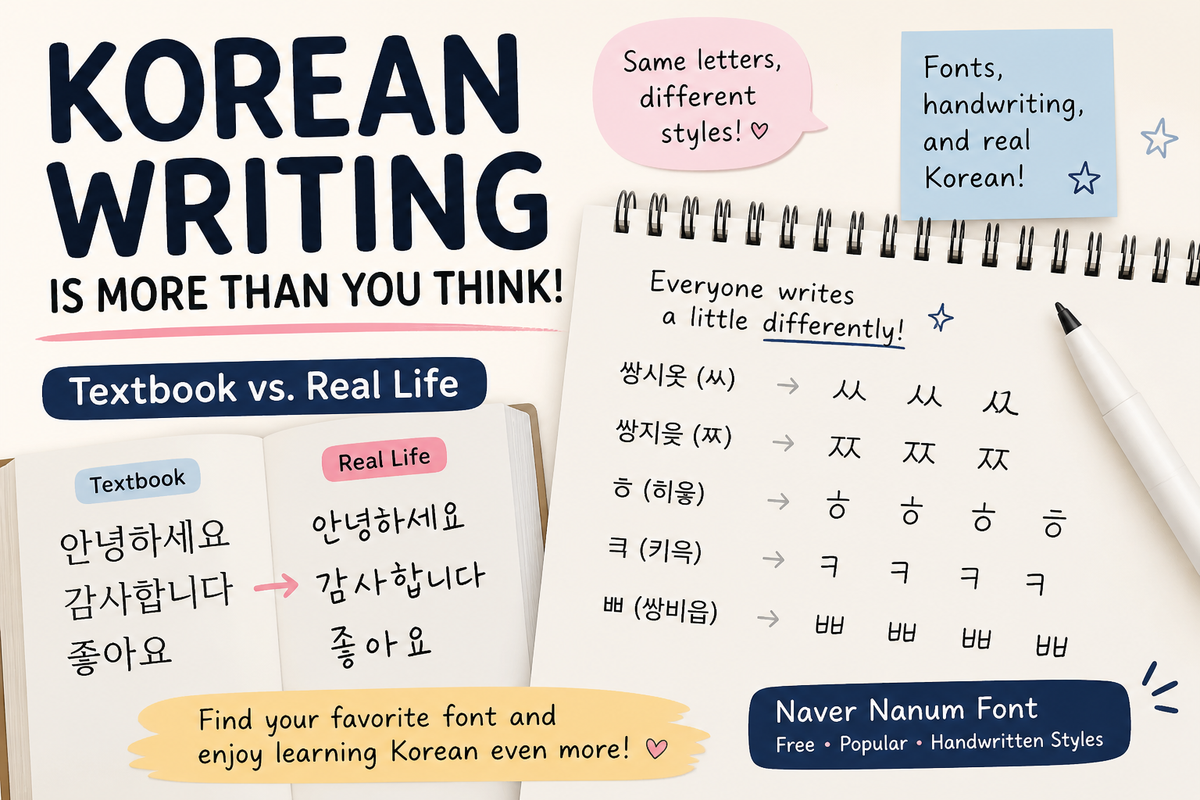
The way you learn Hangul in textbooks
and the way people actually write
can be quite different.
One thing I noticed while teaching students is this:
👉 When students look at the font I use, they sometimes say,
“I'm not sure what this character is.”
Examples of Different Writing Styles
Here are a few examples:
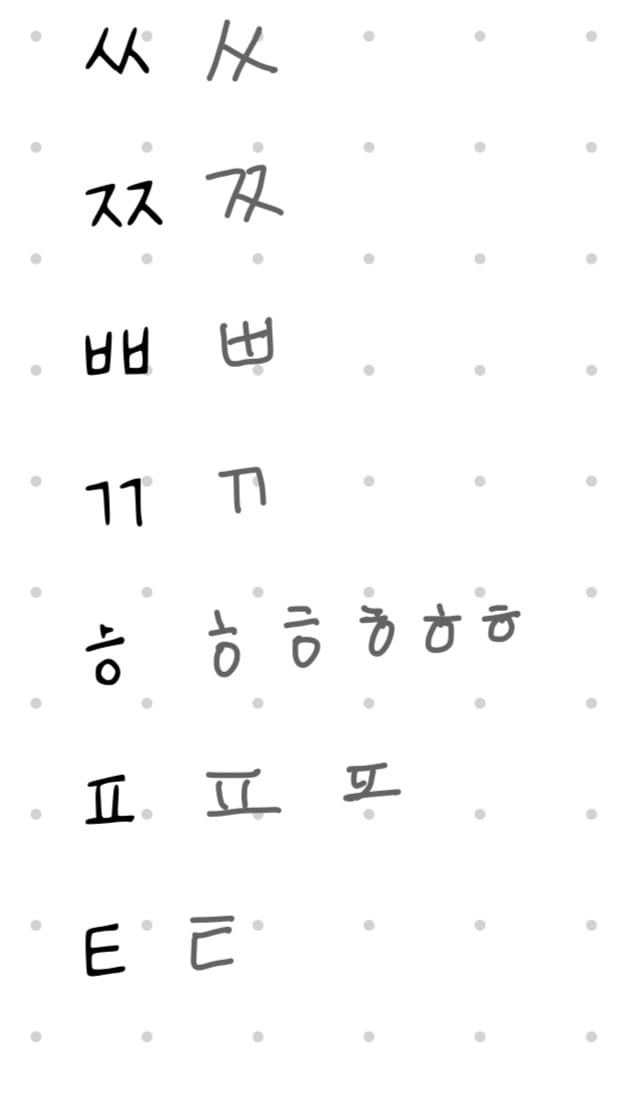
1️⃣ ㅆ (double siot)
- Standard: two ㅅ characters
- Variation: one ㅅ with an extra line added on top
2️⃣ ㅉ (double jieut)
- Standard: two ㅈ characters
- Variation: ㅈ combined with a ㄱ-like shape
3️⃣ ㅎ
- Some people draw the top line horizontally
- Others draw it vertically
- Some connect the strokes, while others separate them
4️⃣ ㅋ, ㅍ
- Standard: written with multiple strokes
- In real life: often written quickly in fewer strokes
5️⃣ ㅃ (double bieup)
- Standard: two ㅂ characters
- Variation: one large ㅂ with an added line inside
Why Does This Happen?
This happens naturally because
👉 everyone has their own writing style.
Especially when people:
- write quickly
- write casually
- develop personal habits
their handwriting changes.
Writing Style Can Be Personal
There’s another interesting point here.
Korean fonts are actually very diverse.
So instead of just learning how to write letters,
👉 finding a writing style you like
can also make learning Korean more enjoyable.
For example, one of the most commonly used font families in Korea is:
👉 Naver Nanum Font
It’s widely used because it’s free
and can be used for commercial purposes.
Within the Nanum font family,
there are also many handwriting-style fonts.
Some of them are even based on real people’s handwriting.
So if you want to:
👉 improve your handwriting
👉 or learn a natural writing style
you can try:
👉 choosing a font you like
👉 and practicing by following that style
Final Thoughts
Language is not limited to what we learn in textbooks.
👉 The way it is used in real life can look quite different.
So instead of thinking,
👉 “This is the only correct way,”
it might be more helpful to think,
👉 “This is one of many possible ways.”
If you’re learning Korean,
being aware of different writing styles
can help you feel much more comfortable in real-life situations 🙂